
Lesson 12
The complex frequency domain
Learn to solve complex-frequency domain problems using FD. Move between the time domain and the s-domain with the t2s and s2t shortcuts. Learn to solve transfer function problems.
Last updated 2023-07-08
Every analysis so far has answered in the same domain you asked in. This one does not, and that is the point of it: the complex frequency domain, or s-domain, is where a differential equation becomes an algebraic one. Symbulator will do the algebra; your job is to be clear about which domain each number is in.
12.1s-domain analysis
Symbulator has an analysis type called FD — complex frequency domain that solves a circuit in the domain of complex frequency, where \(s = j\omega\).
The rule that matters is this one, and it catches everybody once:
The same applies to what comes back: FD answers in s. Voltages and currents are functions of s, and if you want them in time you have to transform them back.
Resistances are read in the s-domain too, which is more useful than it sounds: it means you can describe a capacitor or an inductor as an impedance, writing its value in terms of s, as long as its initial condition is zero.
Other than the domain, FD and TR are twins. Capacitors and inductors given in farads and henries are described identically in both, and so is everything else — shorts, op-amps, transformers, all of it.
AS7's Example 16.1
Find vo(t) in the circuit, assuming zero initial conditions.

AS7's Example 16.1
Solution
Before we start: this problem does not need the s-domain at all. The source is given as a function of time and the answer is wanted as a function of time, so TR will do it in one step. Notice that the source value is written in the time domain, because that is what TR reads:
e,1,0,u(t)
r1,1,2,1
r2,2,o,5
c,2,0,1/3,0
l,o,0,1,0
Run it in TR. The answer is vo:
in TR, the one-step wayOpen in app ↗Open in split view
Now let us do it properly, in the s-domain, which is what you would want if any of the intermediate answers interested you.
The extreme version describes everything as an impedance in s — the source as 1/s, the capacitor as 3/s, the inductor as s:
e,1,0,1/s
r1,1,2,1
r2,2,o,5
r3,2,0,3/s
r4,o,0,s
in FD, everything as an impedanceOpen in app ↗Open in split view
That was to prove it can be done. In practice the schematic gives you farads and henries, so give Symbulator farads and henries and let it do the converting:
e,1,0,1/s
r1,1,2,1
r2,2,o,5
c,2,0,1/3,0
l,o,0,1,0
Choose FD — complex frequency domain.
in FD, farads and henriesOpen in app ↗Open in split view
Both give the same answer, in the s-domain:
Note the source: 1/s, not 1. The unit step is 1/s in the s-domain, and writing 1 there would have described an impulse instead.
12.2The t2s and s2t shortcuts
Having to transform every source by hand before typing it, and every answer by hand afterwards, would make the s-domain more trouble than it saves. Symbulator gives you both directions.
t2s(expression) converts an expression that is a function of time into its s-domain equivalent, and s2t(expression) converts back. Both work wherever you can write an expression: in a source value, in Evaluate, and in the Solve card.
So the whole problem can be done in the s-domain while you write the source in the domain the schematic gave it to you in:
e,1,0,t2s(u(t))
r1,1,2,1
r2,2,o,5
c,2,0,1/3,0
l,o,0,1,0
Run that in FD, then put the answer back into the time domain from Evaluate:
s2t(vo)in FD, and back to timeOpen in app ↗Open in split view
The curly-bracket shorthand
Wrap the value in curly brackets — {u(t)} — and FD reads it as t2s(u(t)). It works only inside a circuit description, so the answer still needs s2t(...) when you ask for it in Evaluate.
12.3Instructive FD problems
AS7's Practice Problem 16.1
Open in app ↗Open in split view
Determine vo(t) in the circuit.
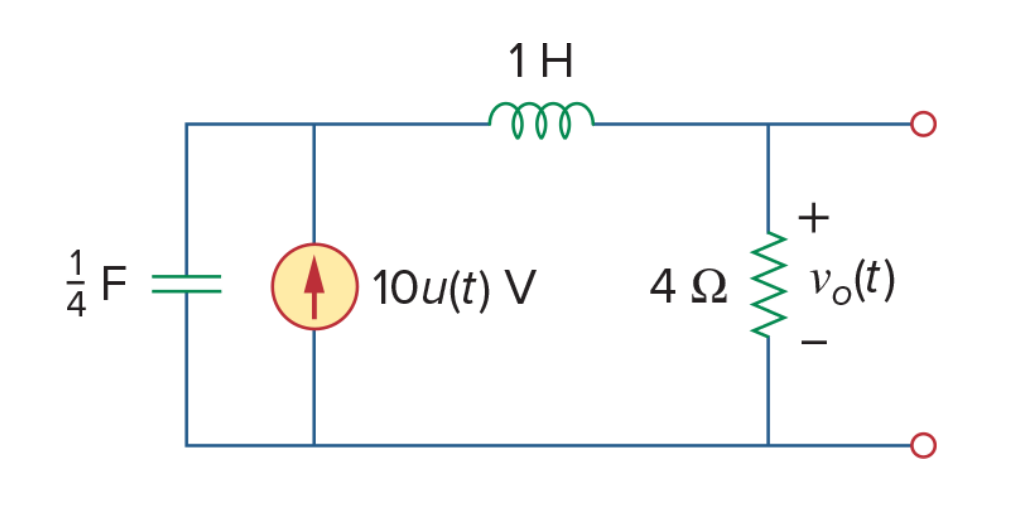
AS7's Practice Problem 16.1
Solution
The same shape as the example above, so the same approach: describe it in FD with the source converted, then transform the answer back.
e,1,0,t2s(u(t))
r1,1,2,6
c,1,0,1/4,0
l,1,o,2,0
r2,o,0,3
FD, then s2t(vo) in Evaluate.
12.4Transfer function problems
A transfer function is a ratio of two answers, so there is nothing new to learn: solve the circuit with a symbolic source, then divide.
Because both answers are functions of s, so is their ratio — which is exactly what a transfer function is meant to be.
NR11's Example 13.7
Open in app ↗Open in split view
Find the transfer function H(s) = Vo/Vs.
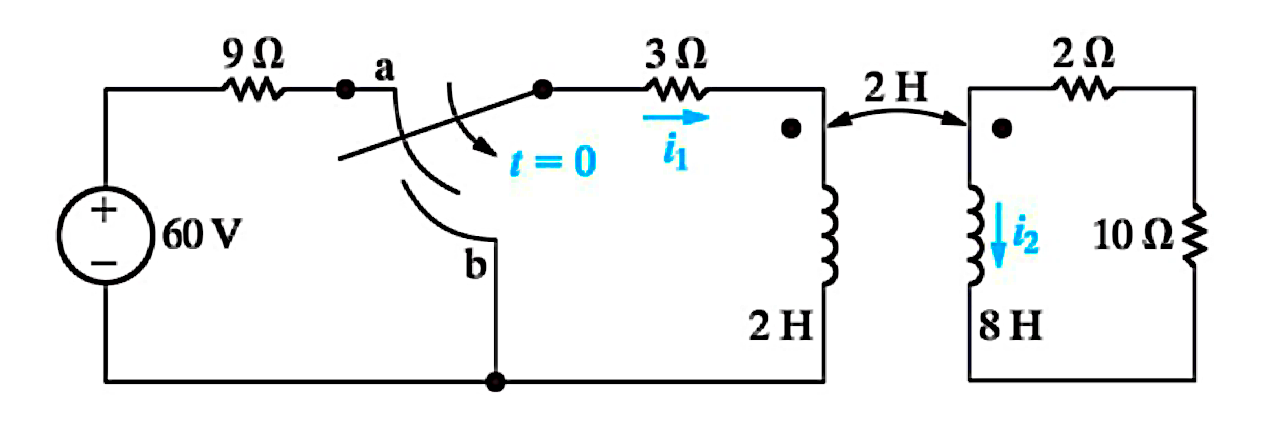
NR11's Example 13.7
Solution
Give the source a symbolic value and solve in FD:
e,1,0,vs
r1,1,2,1'k
c,2,0,1'µ
r2,2,o,1'k
Solve in FD, then ask Evaluate for the ratio:
vo/vsThe answer is a function of s, as a transfer function should be.