
Lesson 4
Shorts, equivalent resistance and Thévenin/Norton
Learn how to describe a short circuit using the s element. Learn how to find equivalent resistances, and Thévenin and Norton equivalents.
Last updated 2023-07-08
In this lesson you will learn how to describe a short circuit with the s element, how to find equivalent resistances, and Thévenin and Norton equivalents.
4.1How to describe a short circuit
Shorts are used mostly to find a current in a part of the circuit with no element in it already. Otherwise we would just make it a single node.
What answers do you get
No power is consumed, and no voltage is dropped, in a short circuit. For each short in a circuit, Symbulator gives only the current through it, flowing from the first node towards the second. For a short called sx, that is isx.
HK5's Drill Problem 1-13
Open in app ↗Open in split view
Find i1, i2, i3 and i4.

HK5's Drill Problem 1-13
Solution
My solution: I define the shorts in the same direction as the arrows in the schematic.
r1,1,0,25
jd,0,2,0.2*v1
r2,2,3,10
ji,4,3,2.5
r3,4,5,100
s1,1,2
s2,2,4
s3,0,3
s4,3,5
Choose Solve circuit and DC, then run it. The current through each short is given in:
is1 = -2 A, is2 = 3 A, is3 = -8 A and is4 = -0.5 A.
These are correct, and they can only be found using short circuits.
4.2Finding the equivalent resistance
As we saw, Symbulator gives the equivalent resistance of a circuit as seen from any source. That lets us solve problems like this one.
AS2's Practice Problem 2.15
Open in app ↗Open in split view
Find the equivalent resistance as seen by the 100 V source, and the value of current i.

AS2's Practice Problem 2.15
Solution
e,a,0,100
r13,a,1,13
r24,1,2,24
r10,1,3,10
r20,2,3,20
r30,2,0,30
r50,3,0,50
Solve it in DC. Because a source sits between the two nodes we care about, the equivalent resistance is one of the answers already: the resistance seen by the source, re, is 40 Ω.
The current i is the current through r13: ir13 = 2.5 A.
Both answers came free, because there was a source connected between the two desired nodes. The rest of this lesson is about what to do when there is not.
What if there is no independent source?
But how do we find the equivalent resistance of a passive circuit, one with no independent source in it? One way is to connect a 1 A current source between the two nodes and read the voltage drop across it. That is the manual way.
An easier way is to let Symbulator do that for us.
Set Type of analysis to Find equivalent, and a second menu appears, Type of equivalent, whose first entry is Resistance / impedance. Two node boxes appear with it, for the terminals you are measuring between. Symbulator does the 1 A trick internally and reports the answer.
B11's Example 8.29
Open in app ↗Open in split view
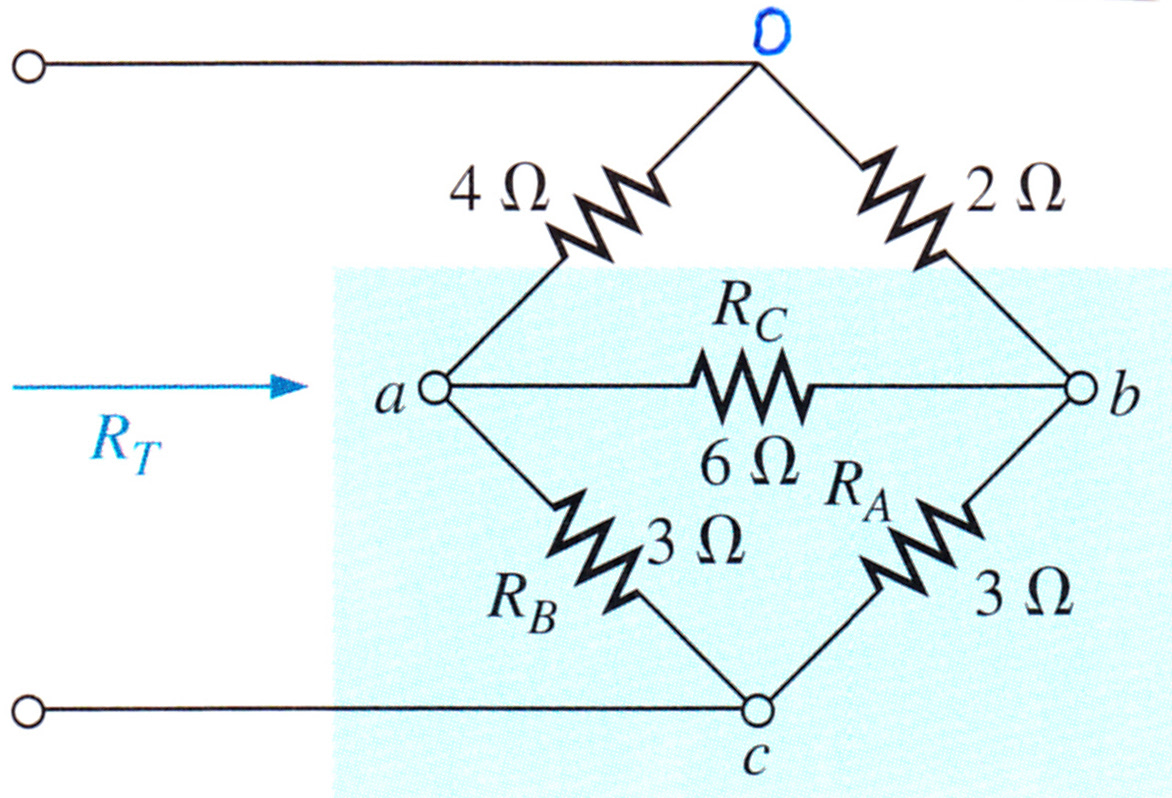
Calculate the equivalent resistance of the circuit shown.
B11's Example 8.29
Solution
My solution: I label the nodes, then describe the circuit.
r4,0,a,4
r2,0,b,2
r6,a,b,6
rb,a,c,3
ra,b,c,3
Set Type of analysis to Find equivalent, Type of equivalent to Resistance / impedance, and the two node boxes to 0 and c. Leave Analysis on DC — direct current and press Run Symbulator.
Results looks different from a normal solve: instead of the node and element listing there is a single answer, headed equivalent resistance:
Req = 2.89 Ω
This is correct.
What counts as passive
That example was made of resistors only. Resistance / impedance also handles a second kind of passive circuit: one with resistors and dependent sources, but no independent sources. Such a circuit can only be reduced to an equivalent resistance, not to a Thévenin or Norton equivalent, so it is found in exactly the same way, provided the dependent sources are described properly.
4.3Finding a Thévenin / Norton equivalent
Just as a passive circuit can be reduced to an equivalent resistance, an active circuit — one with independent sources — can be reduced to a Thévenin or Norton equivalent.
One way is to run a first simulation for the voltage between the two nodes where we want the equivalent (the Thévenin voltage, VTH), then a second with a short between those nodes for the current through it (the Norton current, INO). REQ is then VTH/INO. That is the manual way.
An easier way is to let Symbulator do exactly that automatically: set Type of analysis to Find equivalent and Type of equivalent to Thévenin / Norton, and give it the two nodes.
RM3's Practice Problem 9-4
Open in app ↗Open in split view
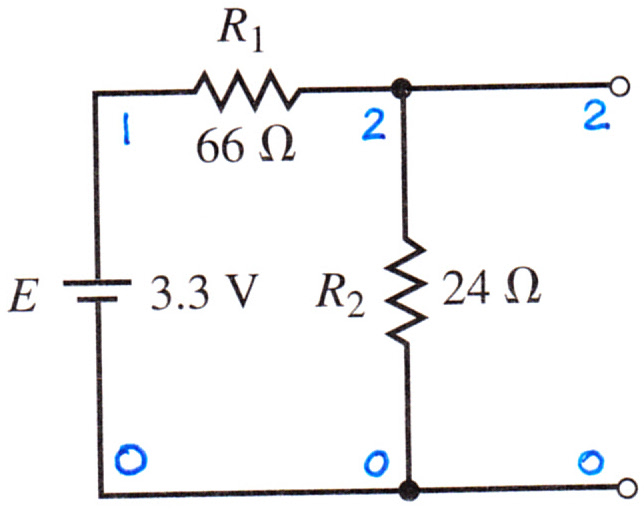
Find the Thévenin and Norton equivalents of the circuit.
RM3's Practice Problem 9-4
Solution
This is my circuit description:
e,1,0,3.3
r1,1,2,66
r2,2,0,24
Set Type of analysis to Find equivalent and Type of equivalent to Thévenin / Norton. Two node boxes appear: put 2 in the first and 0 in the second — the pair of terminals you are looking into. Leave Analysis on DC — direct current and press Run Symbulator.
Results replaces the node-and-element listing with a single group headed Thévenin / Norton equivalent, holding four answers:
- vth has the Thévenin voltage
- ino has the Norton current
- req has the equivalent resistance
- pmax has the maximum power that the equivalent can deliver to a hypothetical load
Here they read vth = 880 mV, ino = 50 mA, Req = 17.6 Ω and pmax = 11 mW. The first three are what you came for; the fourth is the most this circuit could deliver into a matched load.
Problems with a load
One type of problem books and professors like when teaching the Thévenin / Norton equivalents is what I call an RL problem. A typical one goes like this: "First, reduce the circuit, as seen by resistor RL, to its Thévenin or Norton equivalent. Then, find the value of the voltage drop, current and/or power consumed in the load resistor RL if its value is (whatever) ohms."
Since this is such a typical problem, Symbulator makes provision for it. When the equivalent asked for is Thévenin / Norton, a question appears under the two node boxes: Are you running a problem with a load connected to this equivalent circuit? Tick it, and Results adds three answers under the four, each an expression in terms of the variable load, the value of the load resistor:
- irl has the current in the load
- vrl has the voltage drop in the load
- prl has the power consumed in the load
To read one of them at a given load, ask Evaluate for its name and put the load's value in the Conditions box, as in load = 2. Untick the question and the four answers are all you see.
B11's Example 9.6
Open in app ↗Open in split view
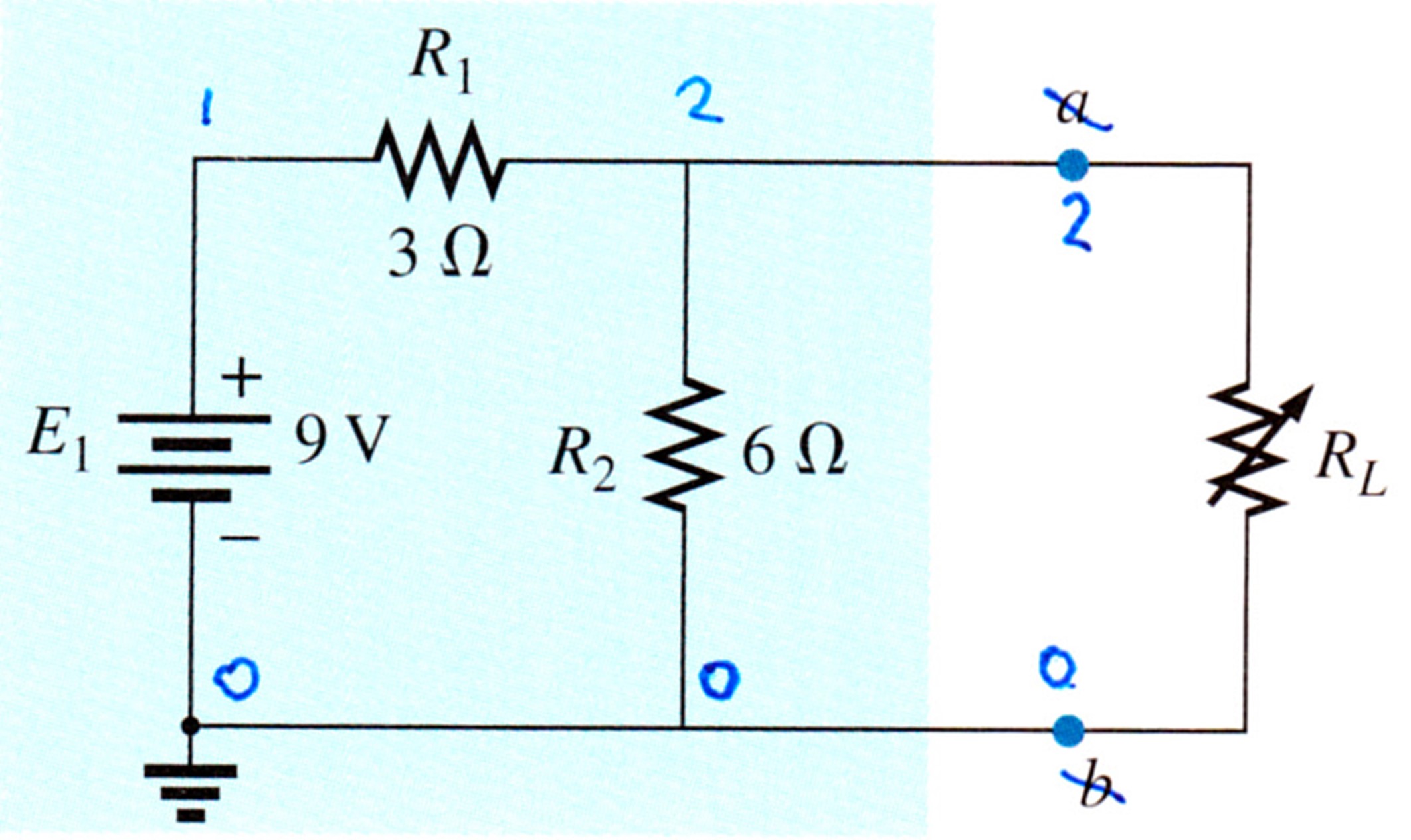
Find the Thévenin equivalent circuit for the network in the shaded area. Then find the current through RL for RL values of 2 Ω, 10 Ω and 100 Ω.
B11's Example 9.6
Solution
First we find the Thévenin equivalent.
e,1,0,9
r1,1,2,3
r2,2,0,6
Set Type of analysis to Find equivalent and Type of equivalent to Thévenin / Norton. Two node boxes appear: put 2 in the first and 0 in the second. Tick the question about the load. Choose DC and run it.
Results gives:
and, because the load question is ticked:
Correct. Now we find the current in the load for each value.
Here we use Rounding — approx to n digits, with n = 2, in Settings, so the answers read as the book prints them; exact, the third would come back as 1/17. Then ask Evaluate for irl, with the load's value in the Conditions box:
irlload = 2Then load = 10, then load = 100.
The answers are 1.5 A, .5 A and .059 A.
The answers are correct.
Power transfer problems
Another problem often associated with the Thévenin / Norton equivalents is power transfer to a load, particularly the maximum possible. Maximum power is transferred when the load RL equals the REQ of the equivalent. Symbulator gives you the maximum power that can be delivered in pmax, and the power transferred to the load as a function of its value in prl, once the load question is ticked.
What if it's more than a load?
The formulas for the current, voltage and power in the load apply only when a load is the only thing connected to the equivalent circuit. If the problem you want to solve includes something more complicated, you will have to run your own simulation.
To help you in those cases, Symbulator writes that circuit for you: with the load question ticked, a button under the equivalent's answers drops the Norton equivalent, load and all, into the input fields, ready to be added to. When a load is not the only thing attached covers it, with a worked example — optional reading, and nothing else in this lesson depends on it.
4.4Instructive solved examples
Practice problems for resistive circuits
B11's Example 8.29
Open in app ↗Open in split view
Calculate the equivalent resistance of the circuit shown.
You saw this circuit solved step by step in the walkthrough above; here it is again, in the compact form the rest of these problems use.

After I label the nodes, I describe the circuit.
r4,0,a,4
r2,0,b,2
r6,a,b,6
rb,a,c,3
ra,b,c,3
Set Type of analysis to Find equivalent and Type of equivalent to Resistance / impedance, with nodes 0 and c, in DC. The answer is req = 2.889 Ω.
This is correct. Below are many practice examples of this type.
B11's Example 8.30
Open in app ↗Open in split view
Find the equivalent resistance of the circuit.

rac,a,c,6
rad,a,0,9
rab,a,b,6
rcd,c,0,9
rbc,b,c,6
rbd,b,0,9
Find equivalent, Resistance / impedance, nodes a and c, in DC: req is 3.273 Ω.
The problem names the four nodes a, b, c and d. Symbulator needs one of them to be the reference node, so d is called 0 here. Which node you ground makes no difference to the answer in a network with no sources — grounding b gives the same 3.273 Ω.
AS2's Example 2.9
Find the equivalent resistance of the circuit.

We don't need to run a simulation for this. We can reduce it using pr.
4+pr(1+5,2+pr(6,3))+8Evaluate gives the equivalent resistance: 14.4 Ω.
AS2's Practice Problem 2.9
Find the equivalent resistance of the circuit.

We don't need to run a simulation for this. We can reduce it using pr.
2+pr(6,3+pr(4,4+5+3))+1Evaluate gives the equivalent resistance: 6 Ω.
AS2's Example 2.11
Find the equivalent conductance of the circuit.
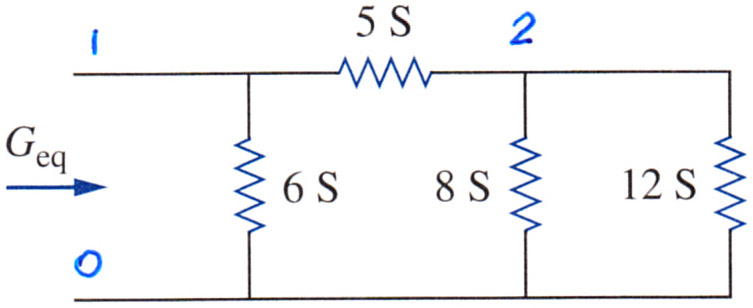
We don't need to run a simulation for this. We can reduce it using pr.
1/(pr(1/6,1/5+pr(1/8,1/12)))Evaluate gives the equivalent conductance: 10 S.
AS2's Practice Problem 2.11
Find the equivalent conductance of the circuit.
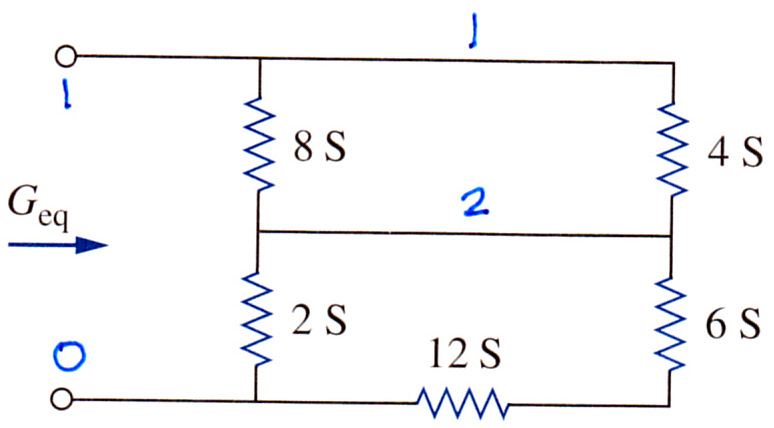
We don't need to run a simulation for this. We can reduce it using pr.
1/(pr(1/8,1/4)+pr(1/2,1/12+1/6))Evaluate gives the equivalent conductance: 4 S.
Examples with dependent sources
Bo2's Drill Problem 3.14
Open in app ↗Open in split view
Find the equivalent resistance of the circuit.

r4,a,0,4
ri,a,0,6
ji,a,0,iri/2
Find equivalent, Resistance / impedance, nodes a and 0, in DC: req is 2 Ω.
AS2's Example 4.10
Open in app ↗Open in split view
Find the equivalent resistance of the circuit.
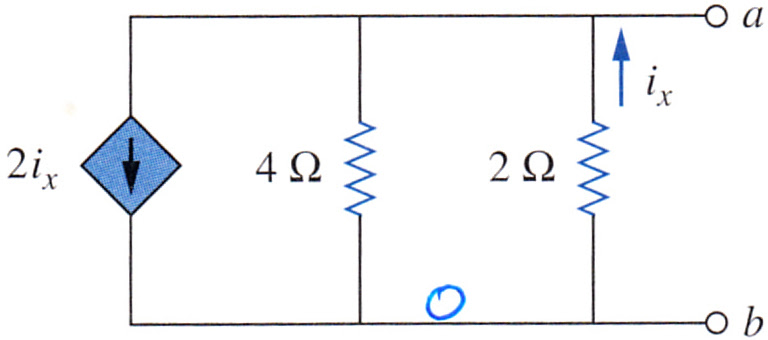
r4,a,0,4
rx,0,a,2
j,a,0,2*irx
Find equivalent, Resistance / impedance, nodes a and 0, in DC: req is -4 Ω. It may be surprising to have a negative resistance. This is the result of the dependent sources.
AS2's Practice Problem 4.10
Open in app ↗Open in split view
Find the equivalent resistance of the circuit.
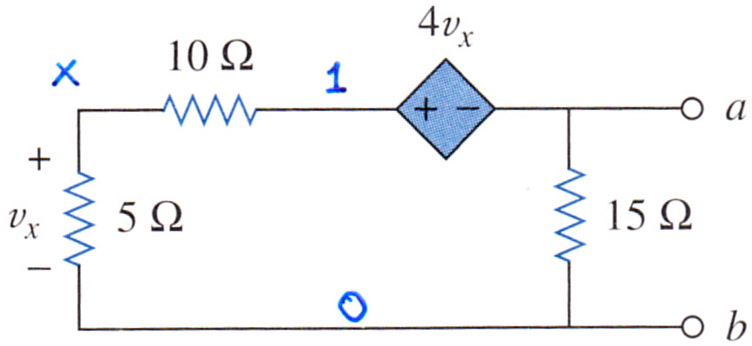
r15,a,0,15
e,1,a,4*vrx
r10,1,x,10
rx,x,0,5
Find equivalent, Resistance / impedance, nodes a and 0, in DC: req is -7.500 Ω.
HK5's Figure 2-29
Open in app ↗Open in split view
Find the equivalent resistance of the circuit.

e,3,0,1.5*is
r3,3,2,3
r2,2,0,2
s,2,1
Find equivalent, Resistance / impedance, nodes 1 and 0, in DC: req is 0.6000 Ω.
HK5's Drill Problem 2-9d
Open in app ↗Open in split view
Find the equivalent resistance of the circuit.
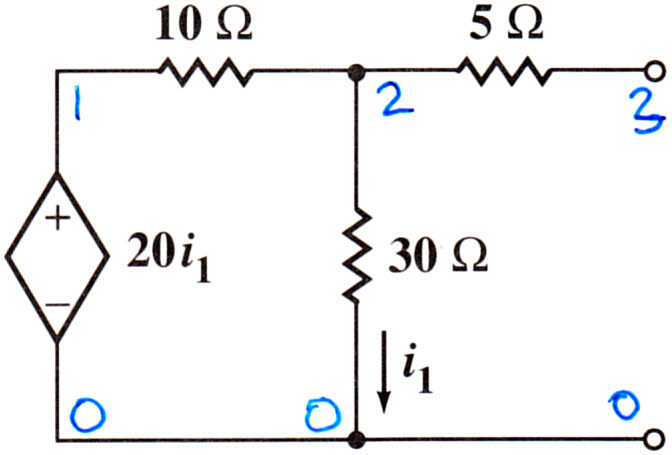
r10,1,2,10
r5,2,3,5
r1,2,0,30
e,1,0,20*ir1
Find equivalent, Resistance / impedance, nodes 3 and 0, in DC: req is 20 Ω.
Bo2's Example 3.12
Open in app ↗Open in split view
Find the equivalent resistance of the circuit.

r1,1,0,6
r4,a,0,4
e,a,1,6*ir1
Find equivalent, Resistance / impedance, nodes a and 0, in DC: req is 3 Ω.
B11's Example 9.7
Open in app ↗Open in split view
Find the Thévenin equivalent of the circuit, as seen from the R3 resistor.
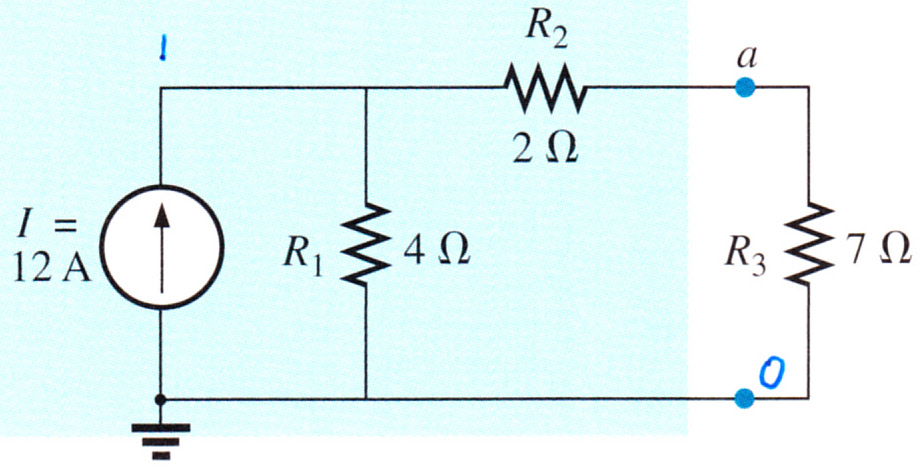
j,0,1,12
r1,1,0,4
r2,1,a,2
Set Type of analysis to Find equivalent and Type of equivalent to Thévenin / Norton. Two node boxes appear: put a in the first and 0 in the second — the pair of terminals you are looking into.
In DC, vth gives VTH = 48 V and req gives REQ = 6 Ω.
B11's Example 9.11
Open in app ↗Open in split view
Find the Norton equivalent of the circuit, as seen from the RL resistor.
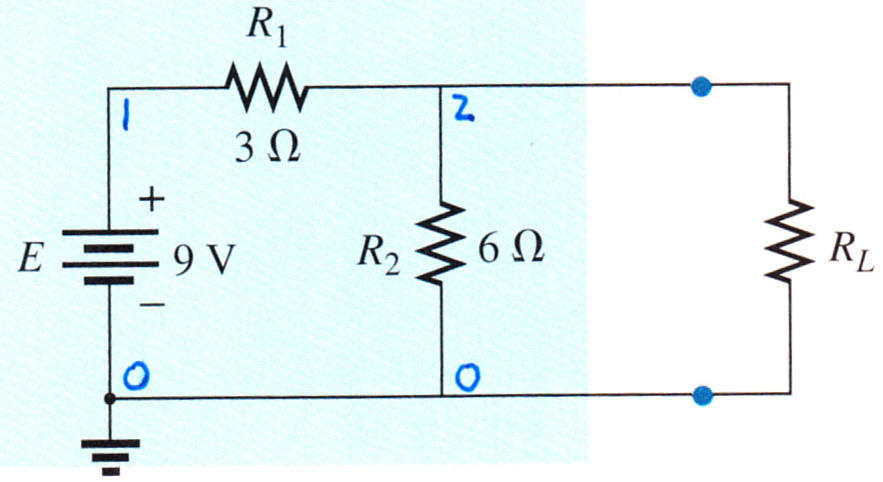
e,1,0,9
r1,1,2,3
r2,2,0,6
Set Type of analysis to Find equivalent and Type of equivalent to Thévenin / Norton. Two node boxes appear: put 2 in the first and 0 in the second — the pair of terminals you are looking into.
In DC, ino gives INO = 3 A and req gives REQ = 2 Ω.
AS2's Practice Problem 4.12
Open in app ↗Open in split view
Find the Norton equivalent of the circuit.
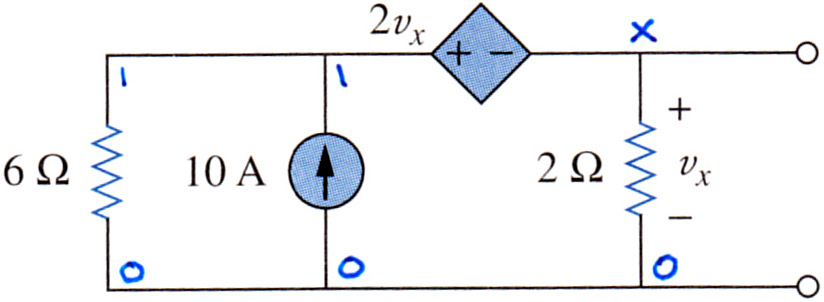
r6,1,0,6
j,0,1,10
r2,x,0,2
e,1,x,2*vx
Set Type of analysis to Find equivalent and Type of equivalent to Thévenin / Norton. Two node boxes appear: put x in the first and 0 in the second — the pair of terminals you are looking into.
In DC, ino gives INO = 10 A and req gives REQ = 1 Ω.
B11's Example 9.12
Open in app ↗Open in split view
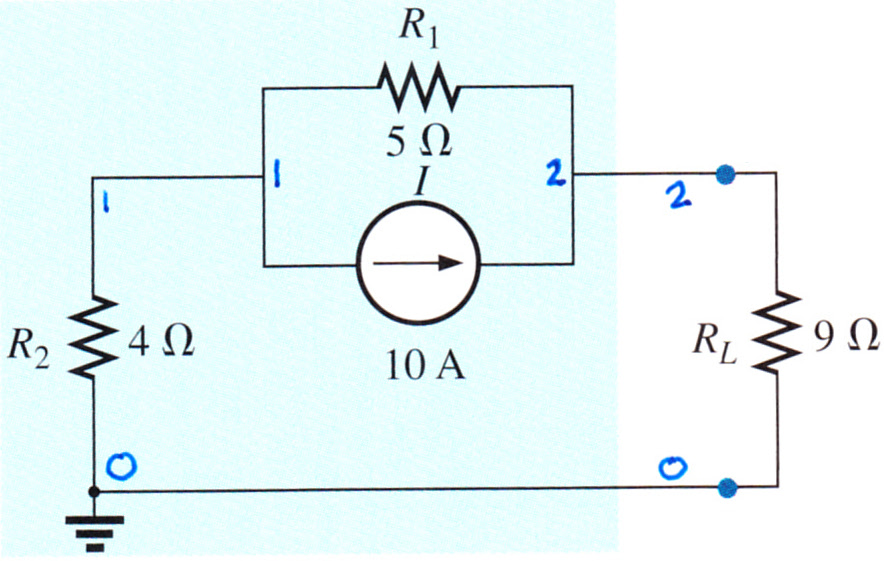
Find the Norton equivalent of the circuit, as seen from the RL resistor.
r2,1,0,4
r1,1,2,5
j,1,2,10
Set Type of analysis to Find equivalent and Type of equivalent to Thévenin / Norton. Two node boxes appear: put 2 in the first and 0 in the second — the pair of terminals you are looking into.
In DC, ino gives INO = 5.56 A and req gives REQ = 9 Ω.
HK5's Drill Problem 2-8b
Open in app ↗Open in split view
Find the Thévenin equivalent of the circuit.

j,0,2,0.01*v1
r,0,2,20
e,1,2,100
Set Type of analysis to Find equivalent and Type of equivalent to Thévenin / Norton. Two node boxes appear: put 1 in the first and 0 in the second — the pair of terminals you are looking into.
In DC, vth gives VTH = 125 V and req gives REQ = 25 Ω.
HK5's Figure 2-27
Open in app ↗Open in split view
Find the Thévenin equivalent of the circuit.
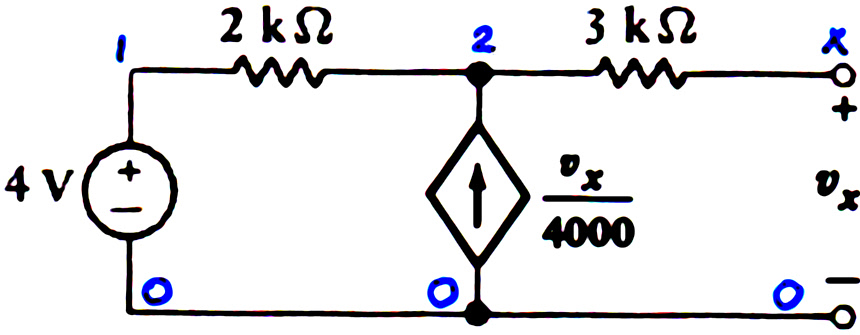
e,1,0,4
r2,1,2,2'k
r3,2,x,3'k
j,0,2,vx/4000
Set Type of analysis to Find equivalent and Type of equivalent to Thévenin / Norton. Two node boxes appear: put x in the first and 0 in the second — the pair of terminals you are looking into.
In DC, vth gives VTH = 8 V and req gives REQ = 10 kΩ.
B11's Example 9.8
Open in app ↗Open in split view
Find the Thévenin equivalent of the circuit, as seen from the R4 resistor.
I ignore the textbook's decision to call the nodes a and b, since b is ground anyway.
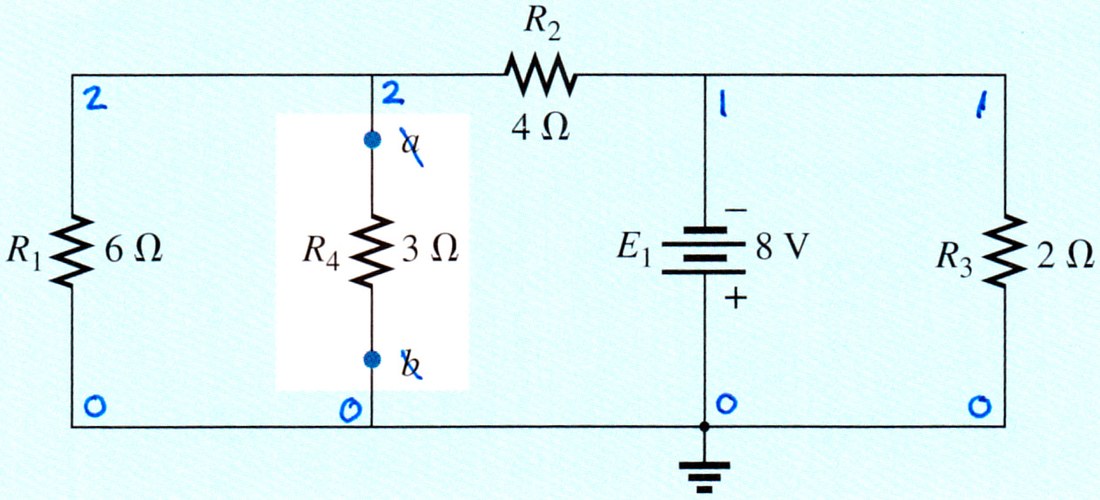
r1,2,0,6
r2,2,1,4
r3,1,0,2
e,0,1,8
Set Type of analysis to Find equivalent and Type of equivalent to Thévenin / Norton. Two node boxes appear: put 2 in the first and 0 in the second — the pair of terminals you are looking into.
In DC, vth gives VTH= -4.8 V and req gives REQ= 2.4 Ω.
B11's Example 8.6
Open in app ↗Open in split view
Find the Norton equivalent of the circuit.

j1,0,1,6
r1,1,0,3
j2,1,0,10
r2,1,0,6
Set Type of analysis to Find equivalent and Type of equivalent to Thévenin / Norton. Two node boxes appear: put 1 in the first and 0 in the second — the pair of terminals you are looking into.
In DC, ino gives INO = -4 A and req gives REQ = 2 Ω.
Bo2's Drill Exercise 3.12
Open in app ↗Open in split view
Find the Norton equivalent of the circuit.
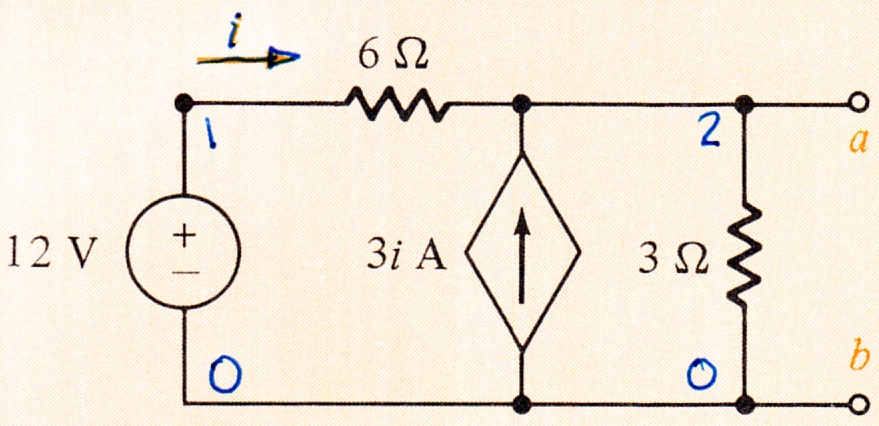
e,1,0,12
r6,1,2,6
j,0,2,3*ir6
r3,2,0,3
Set Type of analysis to Find equivalent and Type of equivalent to Thévenin / Norton. Two node boxes appear: put 2 in the first and 0 in the second — the pair of terminals you are looking into.
In DC, ino gives INO = 8 A and req gives REQ = 1 Ω.
Bo2's Drill Exercise 3.9
Open in app ↗Open in split view
Find the Thévenin equivalent of the circuit.

j,b,0,10
r1,0,b,1
e,a,0,3*ir1
r6,a,b,6
Set Type of analysis to Find equivalent and Type of equivalent to Thévenin / Norton. Two node boxes appear: put a in the first and b in the second — the pair of terminals you are looking into.
In DC, vth gives VTH = 24 V and req gives REQ = 2.4 Ω.
AS2's Example 4.12
Open in app ↗Open in split view
Find Norton equivalent of the circuit.
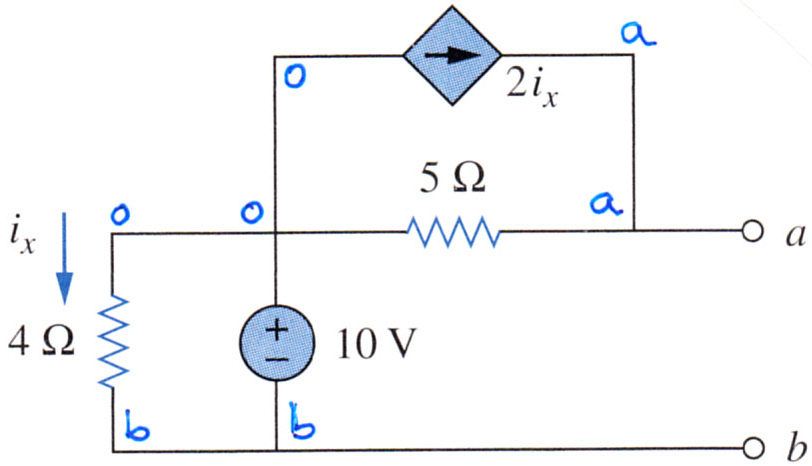
rx,0,b,4
e,0,b,10
r5,0,a,5
j,0,a,2*irx
Set Type of analysis to Find equivalent and Type of equivalent to Thévenin / Norton. Two node boxes appear: put a in the first and b in the second — the pair of terminals you are looking into.
In DC, ino gives INO = 7 A and req gives REQ = 5 Ω.
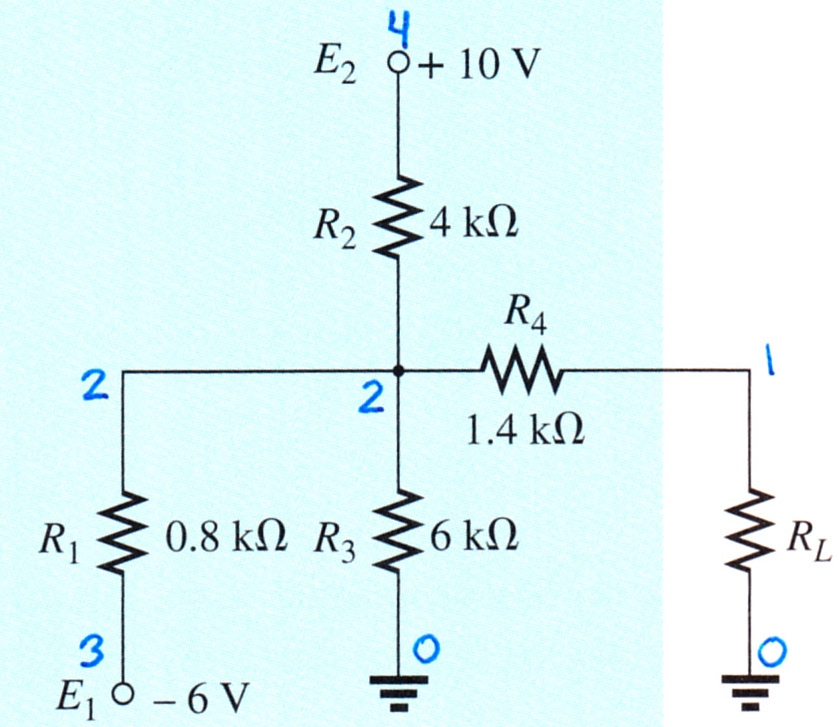
B11's Example 9.9
Open in app ↗Open in split view
Find the Thévenin equivalent of the circuit, as seen from the RL resistor.

e,1,0,72
r1,1,b,6
r2,1,a,12
r3,0,b,3
r4,0,a,4
Set Type of analysis to Find equivalent and Type of equivalent to Thévenin / Norton. Two node boxes appear: put b in the first and a in the second — the pair of terminals you are looking into.
In DC, vth gives VTH = 6 V and req gives REQ = 5 Ω.
AS2's Example 4.11
Open in app ↗Open in split view
Find the Norton equivalent of the circuit.

j,0,2,2
e,4,0,12
r1,2,4,4
r2,2,3,8
r3,0,1,8
r4,3,1,5
Set Type of analysis to Find equivalent and Type of equivalent to Thévenin / Norton. Two node boxes appear: put 3 in the first and 1 in the second — the pair of terminals you are looking into.
In DC, ino gives INO = 1 A and req gives REQ = 4 Ω.
HK5's Drill Problem 2-8a
Open in app ↗Open in split view
Find the Thévenin equivalent of the circuit.
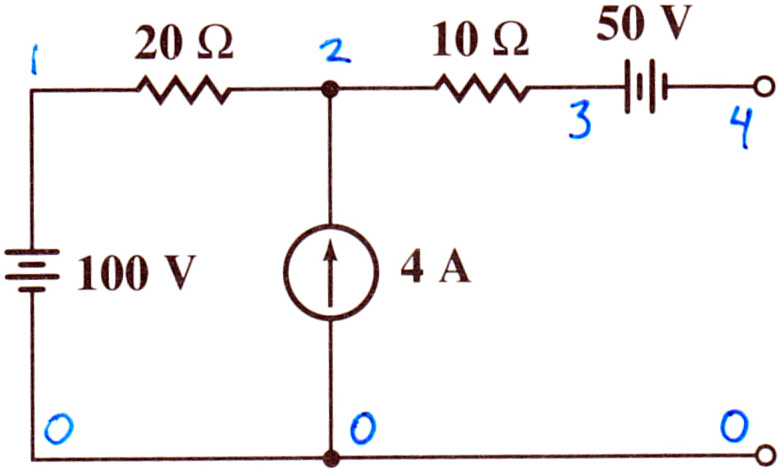
e1,1,0,100
r2,1,2,20
j,0,2,4
r1,2,3,10
e5,3,4,50
Set Type of analysis to Find equivalent and Type of equivalent to Thévenin / Norton. Two node boxes appear: put 4 in the first and 0 in the second — the pair of terminals you are looking into.
In DC, vth gives VTH = 130 V and req gives REQ = 30 Ω.
B11's Example 8.7
Open in app ↗Open in split view
Find Norton equivalent of the circuit.
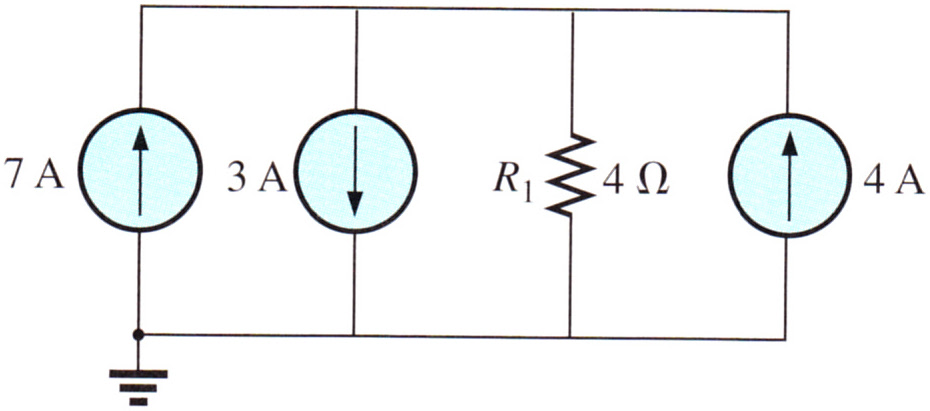
j7,0,1,7
j3,1,0,3
r1,1,0,4
j4,0,1,4
Set Type of analysis to Find equivalent and Type of equivalent to Thévenin / Norton. Two node boxes appear: put 1 in the first and 0 in the second — the pair of terminals you are looking into.
In DC, ino gives INO = 8 A and req gives REQ = 4 Ω.
AS2's Practice Problem 4.9
Open in app ↗Open in split view
Find the Thévenin equivalent of the circuit.
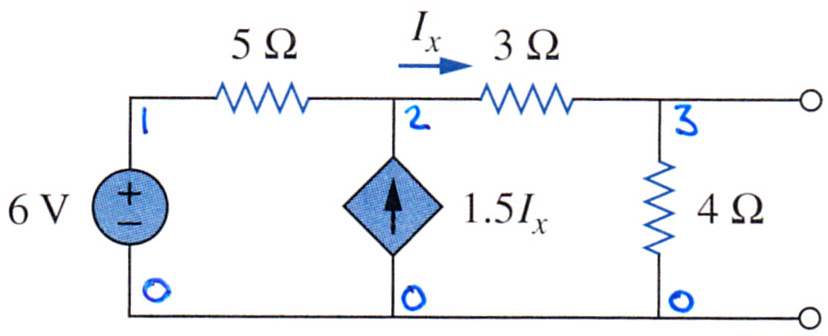
e,1,0,6
r5,1,2,5
rx,2,3,3
j,0,2,1.5*irx
r4,3,0,4
Set Type of analysis to Find equivalent and Type of equivalent to Thévenin / Norton. Two node boxes appear: put 3 in the first and 0 in the second — the pair of terminals you are looking into.
In DC, vth gives VTH = 5.33 V and req gives REQ = 0.44 Ω.
AS2's Example 4.9
Open in app ↗Open in split view
Find the Thévenin equivalent of the circuit.
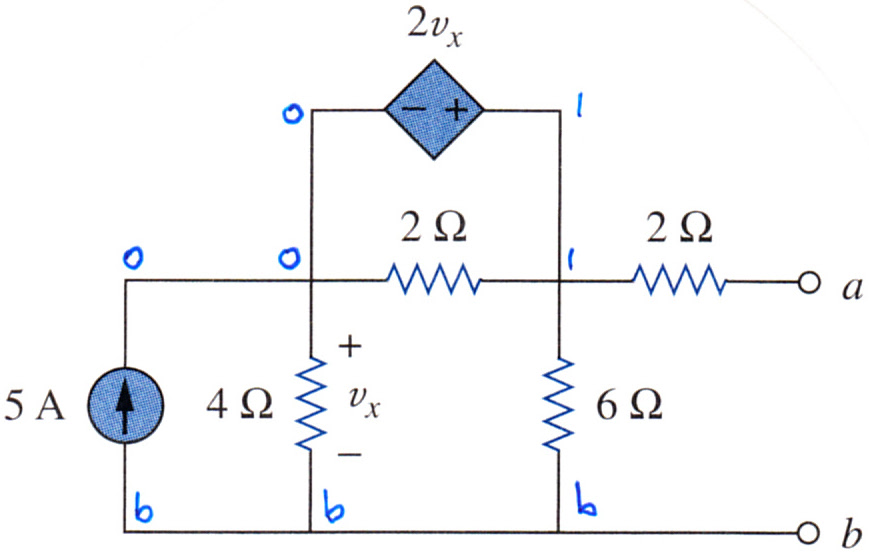
j,b,0,5
rx,0,b,4
r1,0,1,2
r2,1,b,6
r3,1,a,2
e,1,0,2*vrx
Set Type of analysis to Find equivalent and Type of equivalent to Thévenin / Norton. Two node boxes appear: put a in the first and b in the second — the pair of terminals you are looking into.
In DC, vth gives VTH = 20 V and req gives REQ = 6 Ω.
Bo2's Drill Exercise 3.8
Open in app ↗Open in split view
Find the Thévenin equivalent of the circuit.

j,0,1,3
r1,0,1,1
r6,1,2,6
r10,1,3,10
r8,2,0,8
r2,2,3,2
Set Type of analysis to Find equivalent and Type of equivalent to Thévenin / Norton. Two node boxes appear: put 3 in the first and 0 in the second — the pair of terminals you are looking into.
In DC, vth gives VTH = 2 V and req gives REQ = 4 Ω.
B11's Example 9.13
Open in app ↗Open in split view
Find Norton equivalent of the shaded part of the circuit.

e,1,0,7
r1,1,a,4
j,a,0,8
r2,a,0,6
Set Type of analysis to Find equivalent and Type of equivalent to Thévenin / Norton. Two node boxes appear: put a in the first and 0 in the second — the pair of terminals you are looking into.
In DC, ino gives INO = -6.25 A and req gives REQ = 2.4 Ω.
Tricky problems
Some circuit theory books – and some professors – find it entertaining or instructive to surprise unsuspecting students with tricky problems, like the two we solve below.
Bo2's Example 3.11 (Tricky)
Open in app ↗Open in split view
Find the Norton equivalent of the circuit.
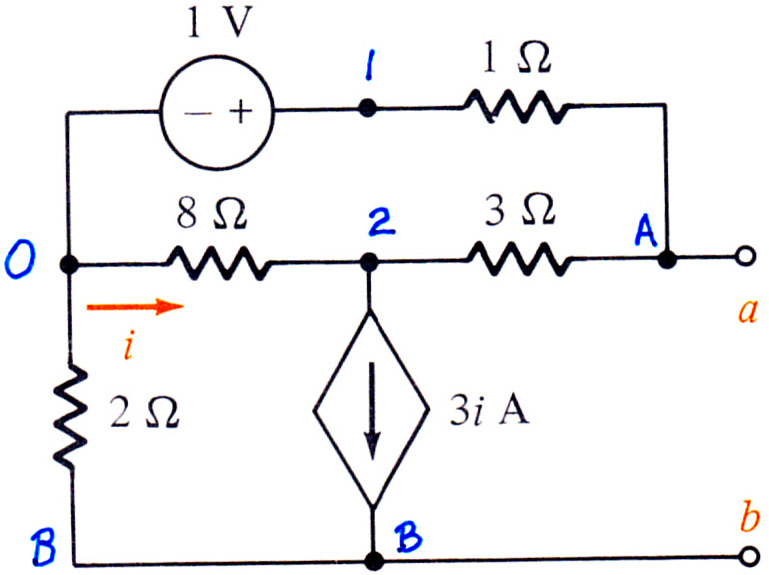
Since you do not know beforehand that this is a tricky problem, you go for the usual:
r2,0,b,2
r8,0,2,8
r3,2,a,3
r1,1,a,1
e,1,0,1
j,2,b,3*ir8
Set Type of analysis to Find equivalent and Type of equivalent to Thévenin / Norton. Two node boxes appear: put a in the first and b in the second — the pair of terminals you are looking into.
Run it in DC and it is refused: Could not solve the system of equations. This often means there is a division by zero somewhere.
Symbulator's own advice is to try again with a symbolic value, which is what we do. We chose to use x instead of 3 in the dependent source.
r2,0,b,2
r8,0,2,8
r3,2,a,3
r1,1,a,1
e,1,0,1
j,2,b,x*ir8
Tricky, with a symbolOpen in app ↗Open in split view
Set Type of analysis to Find equivalent and Type of equivalent to Thévenin / Norton. Two node boxes appear: put a in the first and b in the second — the pair of terminals you are looking into.
Now it solves. The expression for ino is fine, but the one for req,
will divide by zero at \(x = 3\) — the very value we replaced.
The equivalent is in terms of x, so nothing needs running again. Put ino in Evaluate with x = 3 in its Conditions box: INO = 1 A. Ask for req the same way: infinite, the denominator being zero.
This means the equivalent resistance is, for practical purposes, infinite. Your idea of fun, right?
Bo2's Drill Exercise 3.13 (Tricky)
Open in app ↗Open in split view
Another tricky one. Find the Norton equivalent of the circuit.
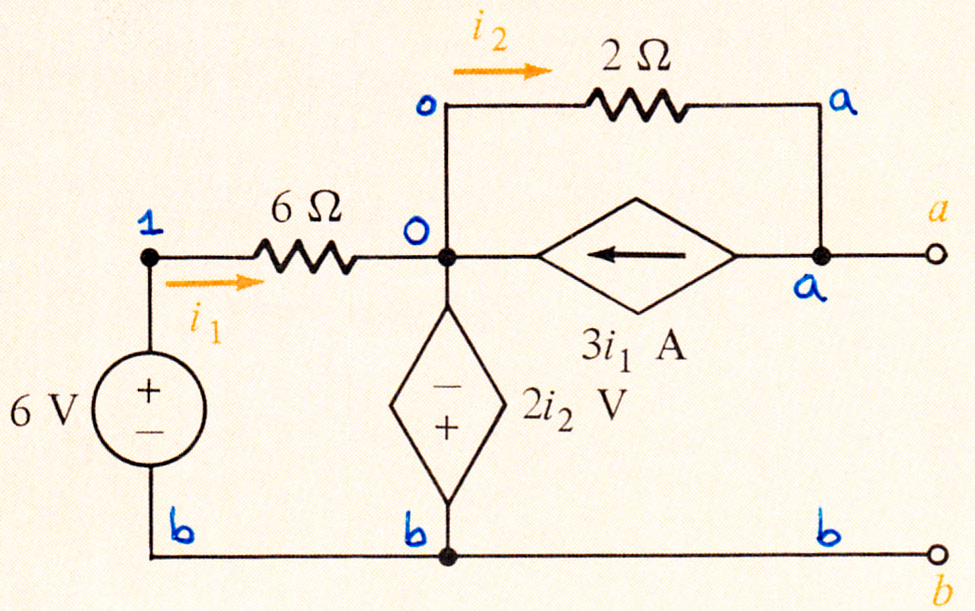
As in the previous example, we get an error if we simulate using 2 and 3 in the dependent sources. So, we use 2x and 3x instead, where x will be later defined as 1.
ei,1,b,6
ed,b,0,2*x*ir2
r1,1,0,6
r2,0,a,2
jd,a,0,3*x*ir1
Set Type of analysis to Find equivalent and Type of equivalent to Thévenin / Norton. Two node boxes appear: put a in the first and b in the second — the pair of terminals you are looking into.
In the answers, the denominator of the expression for req, (x-1), divides by zero at x = 1.
Put ino in the Evaluate card with x = 1 in its Conditions box: INO = -3 A. Ask for req the same way and the answer is infinite, so REQ is undefined at that value.
TR5's Exercise 4-6 (Symbolic)
Open in app ↗Open in split view

First let's find the input resistance, RIN, i.e. the resistance as seen by the vS source. We use μ for the constant in the dependent source.
ei,3,0,vs
rf,3,2,rf
ro,2,t,ro
ed,2,0,μ*vrf
The answer you want is rei, in Results.
It reads rf*(µ+1), which is correct. The textbook's answers are shown right of the circuit schematic. Now we find the output Thévenin equivalent circuit as seen by RL.
ei,3,0,vs
rf,3,2,rf
ro,2,t,ro
ed,2,0,μ*vrf
Symbolic, output equivalentOpen in app ↗Open in split view
Set Type of analysis to Find equivalent and Type of equivalent to Thévenin / Norton. Two node boxes appear: put t in the first and 0 in the second — the pair of terminals you are looking into.
The answers you want are vth and req, in Results.
Results gives
which is correct, as can be seen in the textbook's answers for vT and RT, shown right of the circuit schematic above.
TR5's Example 4-8 (Symbolic)
Open in app ↗Open in split view
Find the Thévenin equivalent as seen by the load.

The dependent source's value is the difference between two node voltages, written straight into the value as va-vb, as Lesson 3 describes.
Now I find the Thévenin equivalent of this circuit description:
ei,a,0,vs
ed,1,0,μ*(va-vb)
ro,b,1,ro
Set Type of analysis to Find equivalent and Type of equivalent to Thévenin / Norton. Two node boxes appear: put b in the first and 0 in the second — the pair of terminals you are looking into.
The answers you want are vth and req, in Results.
The answers we get in Results,
are correct, as can be seen by comparing them to those in the book:

AS2's Example 4.8
Open in app ↗Open in split view
Find the Thévenin equivalent of the circuit shown to the left of terminals a-b. Then find the current through RL = 6, 16 and 36Ω.

My solution:
e,1,0,32.
r4,1,2,4
r12,2,0,12
j,0,2,2
r1,2,3,1
Set Type of analysis to Find equivalent and Type of equivalent to Thévenin / Norton. Two node boxes appear: put 3 in the first and 0 in the second — the pair of terminals you are looking into. Tick the question about the load, choose DC and run it.
The answers you want are vth and req, in Results, and under them the load answers.
Ask Evaluate for irl, with the load in the Conditions box:
irlload = 6Then load = 16, then load = 36.
The answer is vth = 30 V and req = 4 Ω, and irl is 3 A for 6 Ω, 1.5 A for 16 Ω and .75 A for 36 Ω. This is correct.
Bo2's Example 3.10
Open in app ↗Open in split view
Find the Norton equivalent of the circuit left of the a-b terminals, and then find the voltage drop and the current through the ¼ Ω resistor. My solution:
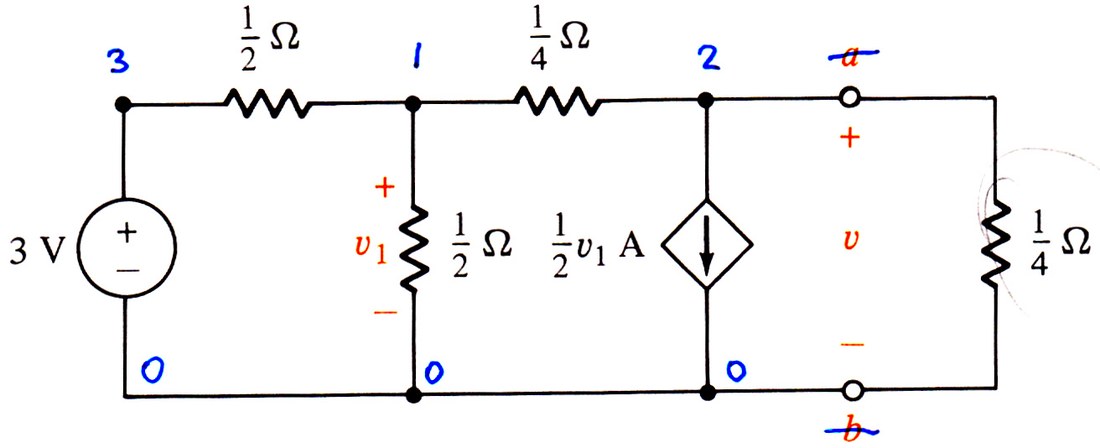
e,3,0,3
r31,3,1,1/2
r10,1,0,1/2
r12,1,2,1/4
j,2,0,v1/2
Set Type of analysis to Find equivalent and Type of equivalent to Thévenin / Norton. Two node boxes appear: put 2 in the first and 0 in the second — the pair of terminals you are looking into. Tick the question about the load, choose DC and run it.
The answers you want are ino and req, in Results, and under them the load answers.
Ask Evaluate for vrl, then for irl, with the load in the Conditions box each time:
vrlload = 1/4The book gives the answers as fractions. We get it right: ino = 21/8 A and req = 4/9 Ω, and at that load vrl = 21/50 V and irl = 42/25 A.
RM3's Example 9-7
Open in app ↗Open in split view
Find the Norton equivalent of the circuit external to RL. Then determine the load current IL when RL = 0 Ω, 2 kΩ and 5 kΩ. My solution:
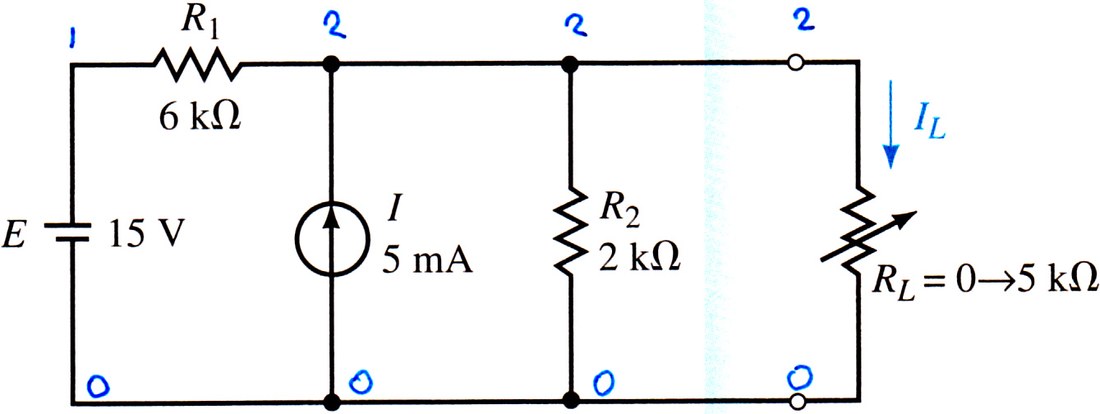
e,1,0,15.
r1,1,2,6'k
j,0,2,5'm
r2,2,0,2'k
Set Type of analysis to Find equivalent and Type of equivalent to Thévenin / Norton. Two node boxes appear: put 2 in the first and 0 in the second — the pair of terminals you are looking into. Tick the question about the load, choose DC and run it.
The answers you want are ino and req, in Results, and under them the load answers.
Ask Evaluate for irl, with the load in the Conditions box:
irlload = 0Then load = 2000, then load = 5000.
The answer is ino = .0075 A and req = 1500 Ω, and irl is .0075 A for 0 Ω, .00321 A for 2 kΩ and .00173 A for 5 kΩ. This is correct.
Bo2's Example 3.5
Open in app ↗Open in split view
Find the Norton equivalent of the circuit external to the 1Ω resistor. Then determine the voltage drop across this 1Ω resistor.

My solution:
e,1,0,24
r12,1,2,12
r20,2,0,4
r23,2,3,4
r34,3,4,2
j,4,0,3
r40,4,0,5
Set Type of analysis to Find equivalent and Type of equivalent to Thévenin / Norton. Two node boxes appear: put 3 in the first and 0 in the second — the pair of terminals you are looking into. Tick the question about the load, choose DC and run it.
The answers you want are ino and req, in Results, and under them the load answers.
Ask Evaluate for vrl, with the load in the Conditions box:
vrlload = 1The answer is ino = -9/7 A and req = 7/2 Ω, and vrl in the 1 Ω load is -1 V. This is correct.
RM3's Example 9-13
Open in app ↗Open in split view
Use Millman's Theorem to simplify the circuit left of a-b so that there is only one voltage and one resistor. Then find the current in the load resistor RL.

I don't know Millman's Theorem, but we can find the Thévenin equivalent with Symbulator.
r1,0,1,240.
e1,2,1,96
r2,0,3,200
e2,3,2,40
r3,0,4,800
e3,2,4,80
Set Type of analysis to Find equivalent and Type of equivalent to Thévenin / Norton. Two node boxes appear: put 2 in the first and 0 in the second — the pair of terminals you are looking into. Tick the question about the load, choose DC and run it.
The answers you want are vth and req, in Results, and under them the load answers.
Ask Evaluate for irl, with the load in the Conditions box:
irlload = 192The answer is vth = 28.8 V and req = 96 Ω, and irl in the 192 Ω load is .1 A. This is correct.
Bo2's Example 3.7
Open in app ↗Open in split view
Find the Thévenin equivalent for the circuit left of a-b. Then find the voltage across the 3 Ω resistor, and also if it was 6 Ω. My answer:

e,1,0,20
r6,1,2,6
r1,1,3,1
r2,3,2,2
j32,3,2,15
j30,3,0,15
Set Type of analysis to Find equivalent and Type of equivalent to Thévenin / Norton. Two node boxes appear: put 2 in the first and 0 in the second — the pair of terminals you are looking into. Tick the question about the load, choose DC and run it.
The answers you want are vth and req, in Results, and under them the load answers.
Ask Evaluate for vrl, with the load in the Conditions box:
vrlload = 3Then load = 6..
The answer is vth = 30 V and req = 2 Ω, and vrl is 18 V for 3 Ω and 22.5 V for 6 Ω. This is correct.
Bo2's Drill Exercise 3.7
Open in app ↗Open in split view
Find the Thévenin equivalent for the circuit left of a-b. Then find the voltage v.
My answer:

e,1,0,8
r3,1,2,3
r12,1,3,12
r6,2,0,6
r2,2,3,2
Set Type of analysis to Find equivalent and Type of equivalent to Thévenin / Norton. Two node boxes appear: put 3 in the first and 0 in the second — the pair of terminals you are looking into. Tick the question about the load, choose DC and run it.
The answers you want are vth and req, in Results, and under them the load answers.
Ask Evaluate for vrl, with the load in the Conditions box:
vrlload = 5.The answer is vth = 6 V and req = 3 Ω, and vrl in the 5 Ω load is 3.75 V. This is correct.
RM3's Practice Problem 9.5
Open in app ↗Open in split view
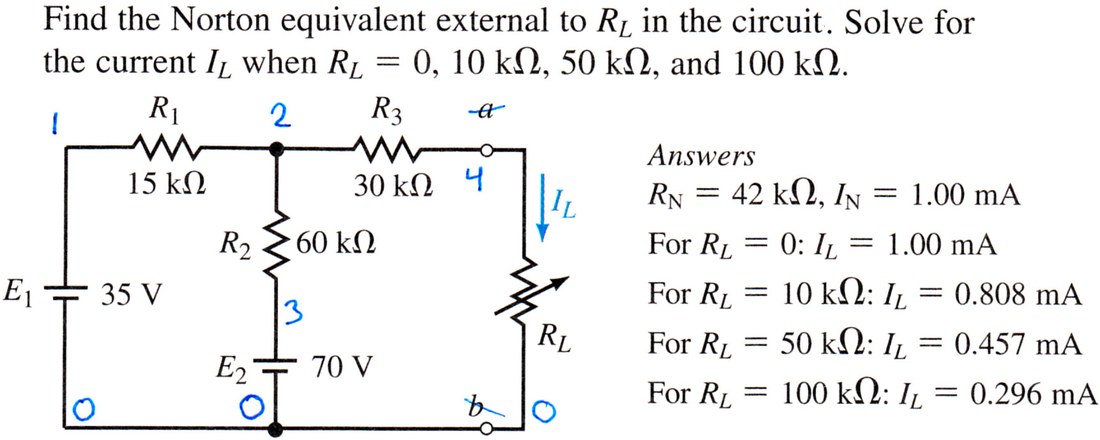
My solution:
e1,1,0,35.
r1,1,2,15'k
r2,2,3,60'k
e2,3,0,70
r3,2,4,30'k
Set Type of analysis to Find equivalent and Type of equivalent to Thévenin / Norton. Two node boxes appear: put 4 in the first and 0 in the second — the pair of terminals you are looking into. Tick the question about the load, choose DC and run it.
The answers you want are ino and req, in Results, and under them the load answers.
Ask Evaluate for irl, with the load in the Conditions box:
irlload = 0Then load = 1e4, then load = 5e4, then load = 1e5.
The answer is ino = .001 A and req = 42000 Ω, and irl is .001 A for 0 Ω, .000808 A for 10 kΩ, .000457 A for 50 kΩ and .000296 A for 100 kΩ. This is correct.
Power transfer problems
AS2's Example 4.13
Open in app ↗Open in split view
Find the RL value for maximum power transfer and the maximum power transferred.

RL for maximum transfer is req. The maximum power is in pmax. My solution:
e,1,0,12
r6,1,2,6
r12,2,0,12
r3,2,3,3
j,0,3,2
r2,3,4,2
Set Type of analysis to Find equivalent and Type of equivalent to Thévenin / Norton. Two node boxes appear: put 4 in the first and 0 in the second — the pair of terminals you are looking into.
The answers you want are req and pmax, in Results.
Here we use Rounding — approx to n digits, with n = 3.
Choose DC. The maximum transfer of power occurs when the load is req = 9Ω, and the power transferred is then pmax = 13.44W. Now let's solve another one.
AS2's Practice Problem 4.13
Open in app ↗Open in split view
Find the RL value for maximum power transfer and the maximum power transferred.
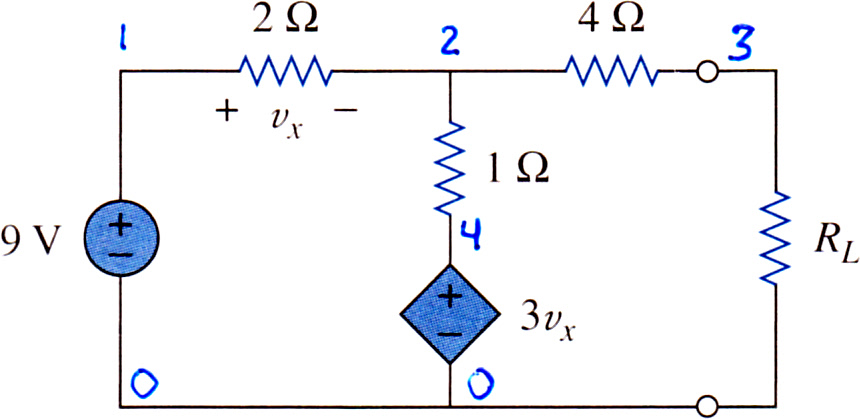
ei,1,0,9
rx,1,2,2
r1,2,4,1
ed,4,0,3*vrx
r4,2,3,4
Set Type of analysis to Find equivalent and Type of equivalent to Thévenin / Norton. Two node boxes appear: put 3 in the first and 0 in the second — the pair of terminals you are looking into.
The answers you want are req and pmax, in Results.
Here we use Rounding — approx to n digits, with n = 3.
Choose DC. The logic of this problem is identical to the previous one. The answer is req = 4.22 Ω and pmax = 2.901 W.
B11's Example 9.15
Open in app ↗Open in split view


My solution to all three questions is presented below.
j,0,1,10'm
rs,1,0,40'k
Set Type of analysis to Find equivalent and Type of equivalent to Thévenin / Norton. Two node boxes appear: put 1 in the first and 0 in the second — the pair of terminals you are looking into. Tick the question about the load, choose DC and run it.
The answers you want are req and pmax, in Results, and under them the load answers.
Ask Evaluate for prl, with the load in the Conditions box:
prlload = 68000.Then load = 8200..
The answers we obtain, req = 40000 Ω and pmax = 1 W, then prl = .93 W and .57 W, are correct. Let's deconstruct it.
Part (a) is answered by the first two values: a 40 kΩ resistor as load would receive 1W power. Since this is the maximum – this is the most that any load could receive ever.
Part (b) is answered by the third value. Making use of prl, the power delivered by the equivalent to the load as a function of load, we find that a load of 68 kΩ receives .93W, which is less than the maximum.
Part (c) is answered in similar manner by the fourth value. A load of 8.2 kΩ receives .57W, which is less than the maximum. Any resistance other than 40 kΩ gets less power.
B11's Example 9.17
Open in app ↗Open in split view
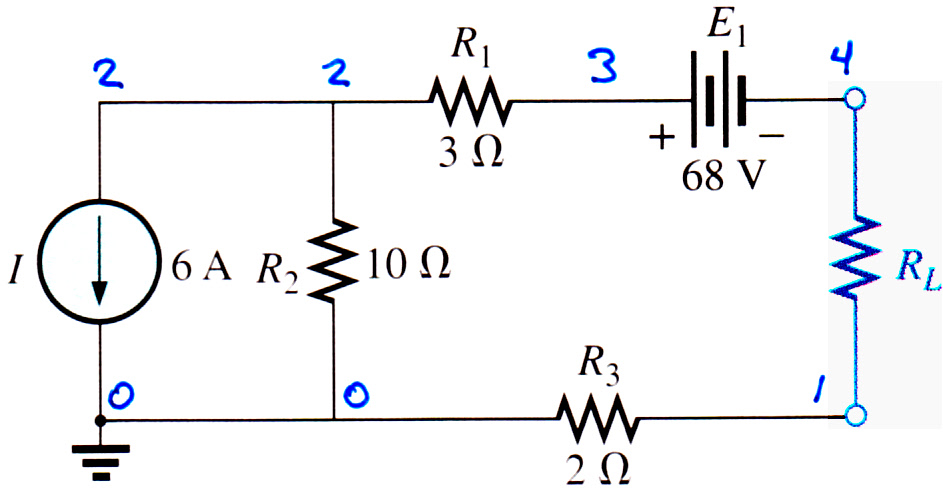
Find the RL value for maximum power transfer and the maximum power transferred.
j,2,0,6
r2,2,0,10
r1,2,3,3
r3,0,1,2
e,3,4,68
Set Type of analysis to Find equivalent and Type of equivalent to Thévenin / Norton. Two node boxes appear: put 4 in the first and 1 in the second — the pair of terminals you are looking into.
The answers you want are req and pmax, in Results.
Here we use Rounding — approx to n digits, with n = 3.
Choose DC. The answer is req = 15 Ω and pmax = 273.07 W. Let's now see one that is a little different.