
Lesson 13
Two-ports
Find the two-port equivalent of a network using the port script. Learn how to include two-ports in your circuit using the z, y, h, g, a and b elements. Calculate gains with the gain tool.
Last updated 2026-08-29
A two-port is a network you have stopped caring about the inside of. What is left is four numbers relating the voltage and current at one pair of terminals to the voltage and current at the other. Symbulator will find those four numbers for you, and will also take them as an element in a larger circuit.
13.1Find two-port equivalents
The tool is called port. It takes the network and the two top nodes of the pair of terminals you want to reduce. The two bottom nodes are always assumed to be ground.
There are six kinds of parameters — z, y, h, g, a and b — and you choose which you want.
AS7's Example 19.1
Determine the z parameters for the circuit.
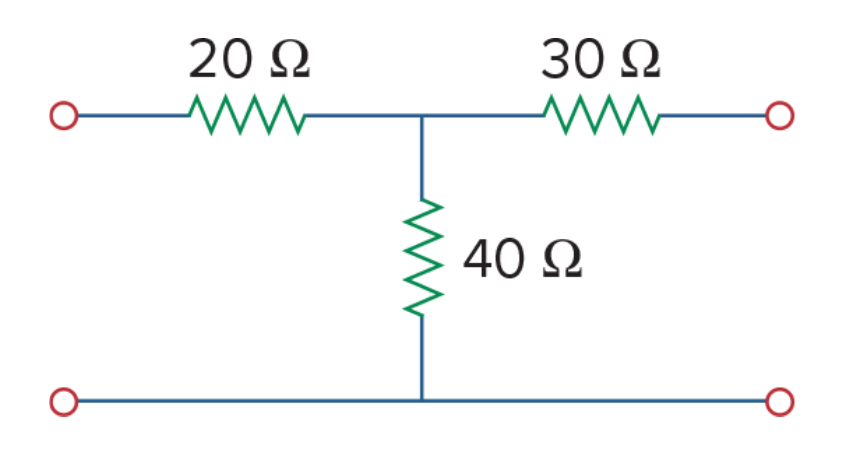
AS7's Example 19.1
Solution
First describe the network, exactly as you would describe any circuit:
"r1,1,2,20:r2,2,0,40:r3,2,3,30"→cir:s\port(cir,1,3)When asked, specify DC as the analysis and z as the parameter type.
Then it wants a name. You may add between one and six more characters, or leave it empty — the Nspire does not reserve z11, z12, z21 and z22, so the two-port can simply be called z.
z11 is 60, z12 is 40, z21 is 40, z22 is 70Correct.
13.2Use two-ports as elements
A two-port can be an element in a bigger circuit. Its description is three fields: a name whose first letter says which kind it is, then the top left node and the top right node. Both bottom nodes are ground, always — which is why neither top node may be 0, and the two may not be the same node; Symbulator stops with a message if they are.
That is a z-type two-port between nodes 1 and 2.
Giving it its four parameters
Three possibilities.
Store them first, in variables named after the two-port plus 11, 12, 21 and 22:
40→z11:𝐢*20→z12:𝐢*30→z21:50→z22Enter them when prompted. If you run a simulation without storing them first, Symbulator asks whether you want to define them, and you can use SI shorthand in the values you type.
Leave them undefined, in which case they stay symbolic and appear as variables in the answers.
What answers do you get? The current entering each port, named with the two-port and the node it sits on — for a two-port z on nodes 1 and 2, that is iz1 and iz2.
AS7's Example 19.2
Find I1 and I2 in the circuit.
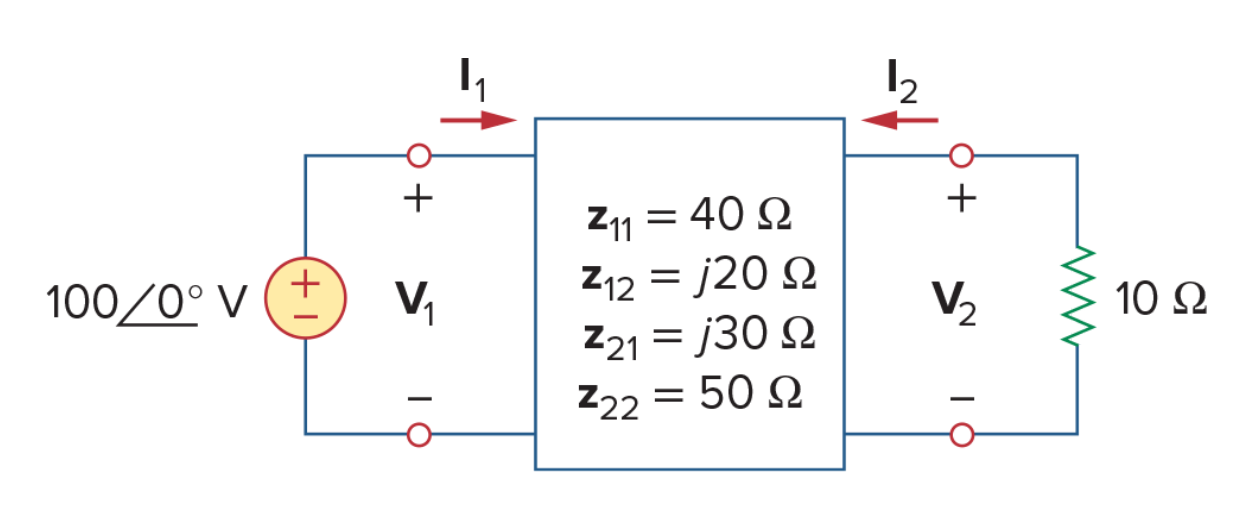
AS7's Example 19.2
Solution
"e,1,0,100:z,1,2:r1,2,0,10"→cir:s\ac(cir,ω)s\aa(iz1)
s\aa(iz2)13.3Instructive two-port problems
AS7's Example 19.3
Obtain the y parameters for the network.

AS7's Example 19.3
Solution
"r1,1,0,4:r2,1,2,2:r3,2,0,8"→cir:s\port(cir,1,2){y11,y12,y21,y22}{3/4,-1/2,-1/2,5/8}Correct.
AS7's Example 19.4
Determine the y parameters for the two-port shown. Note the dependent source.
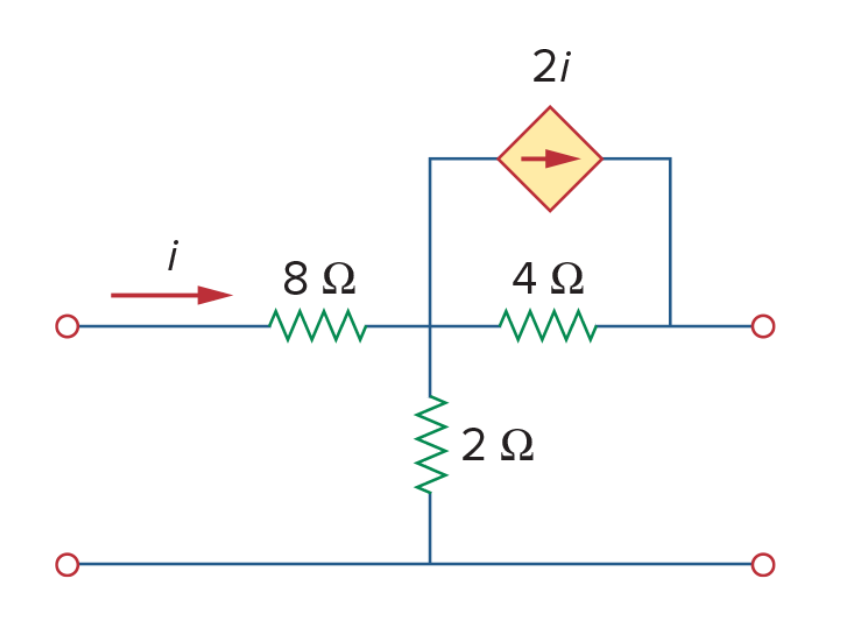
AS7's Example 19.4
Solution
"r1,1,2,8:r2,2,0,2:r3,2,3,4:j,2,3,2*ir1"→cir:s\port(cir,1,3):{y11,y12,y21,y22}{3/20,-1/20,-1/4,1/4}Correct.
AS7's Example 19.5
Find the hybrid parameters for the two-port network.

AS7's Example 19.5
Solution
"r1,1,2,2:r2,2,0,6:r3,2,3,3"→cir:s\port(cir,1,3):{h11,h12,h21,h22}For h, g, a and b there is no name clash, so the single letter is available. Specify DC and h, and leave the extra character empty.
{4,2/3,-2/3,1/9}Correct.
AS7's Example 19.6
Determine the Thévenin equivalent at the output port of the circuit, whose h parameters are 1000 Ω, −2, 10 and 2×10⁻⁴ S.
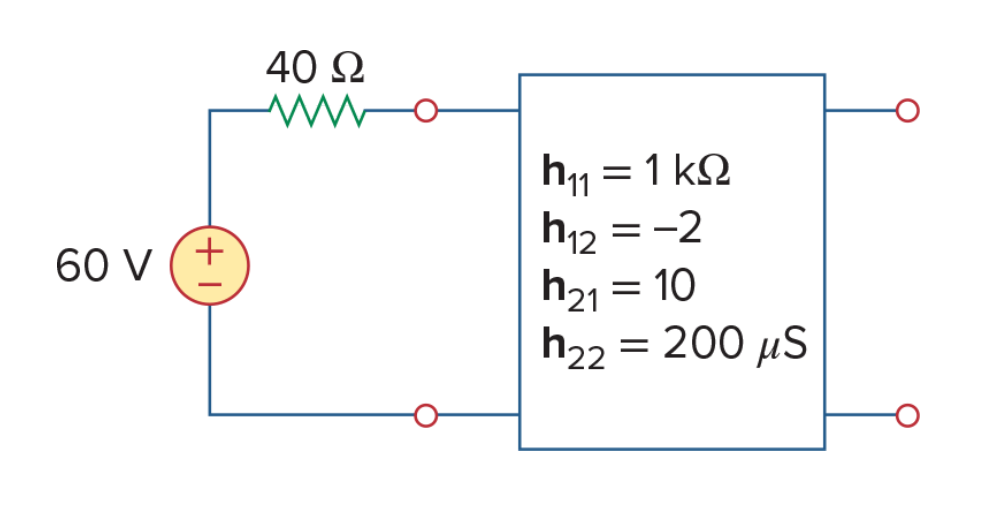
AS7's Example 19.6
Solution
"e,1,0,60:r1,1,2,40:h,2,3"→cir:1000.→h11:-2→h12:10→h21:2.ᴇ-4→h22:s\th(cir,3,0):{vth,req}{-29.69,51.46}Correct.
AS7's Example 19.7
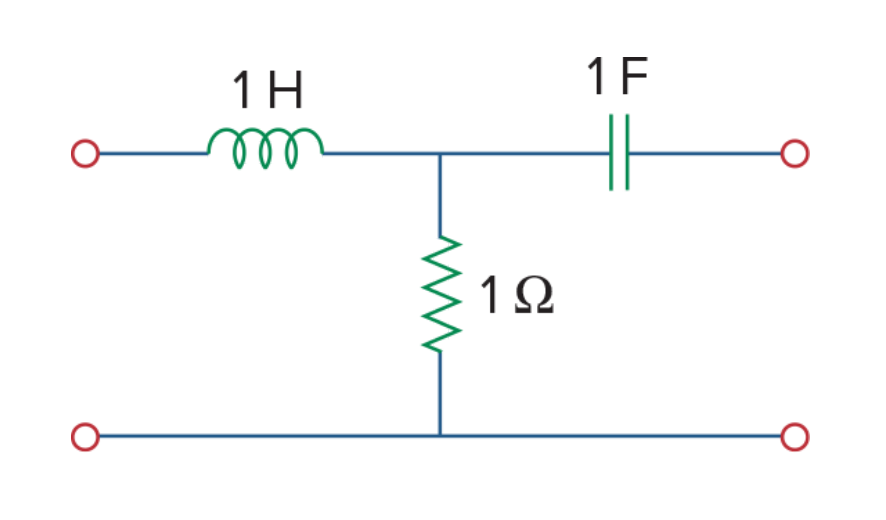
Find the g parameters as functions of s for the circuit.
AS7's Example 19.7
Solution
"l,1,2,1:r1,2,0,1:c,2,3,1"→cir:s\port(cir,1,3):{{g11,g12},{g21,g22}}{1/(s+1),-1/(s+1),1/(s+1),(s^2+s+1)/(s*(s+1))}AS7's Practice Problem 19.7
For the ladder network, determine the g parameters in the s domain.

AS7's Practice Problem 19.7
Solution
"l1,1,2,1:r1,2,0,1:l2,2,3,1:r2,3,0,1"→cir:s\port(cir,1,3):{{g11,g12},{g21,g22}}[[(s+2)/(s^2+3*s+1),-1/(s^2+3*s+1)][1/(s^2+3*s+1),s*(s+2)/(s^2+3*s+1)]]Correct.
AS7's Example 19.8
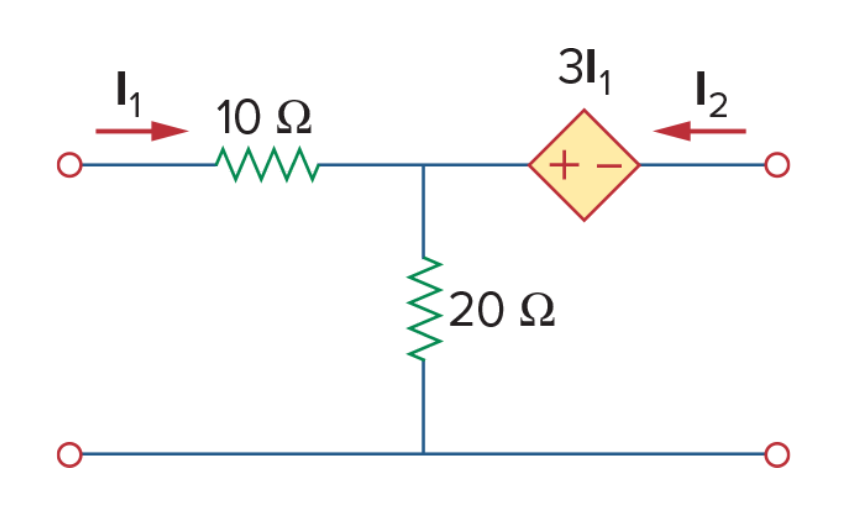
Find the transmission parameters for the two-port network.
AS7's Example 19.8
Solution
"r1,1,2,10:r2,2,0,20:e,2,3,3ir1"→cir:s\port(cir,1,3):[[a11,a12][a21,a22]][[1.765,15.29][.0588,1.176]]Correct.
13.4The gain tool
Network problems ask for gains: voltage gain, current gain, power gain, and the impedance seen at the input. Symbulator has a tool for that, called gain.
It wants four values — the voltage and current at the input, then the voltage and current at the output — and answers with all four figures at once.
Gain Example 1
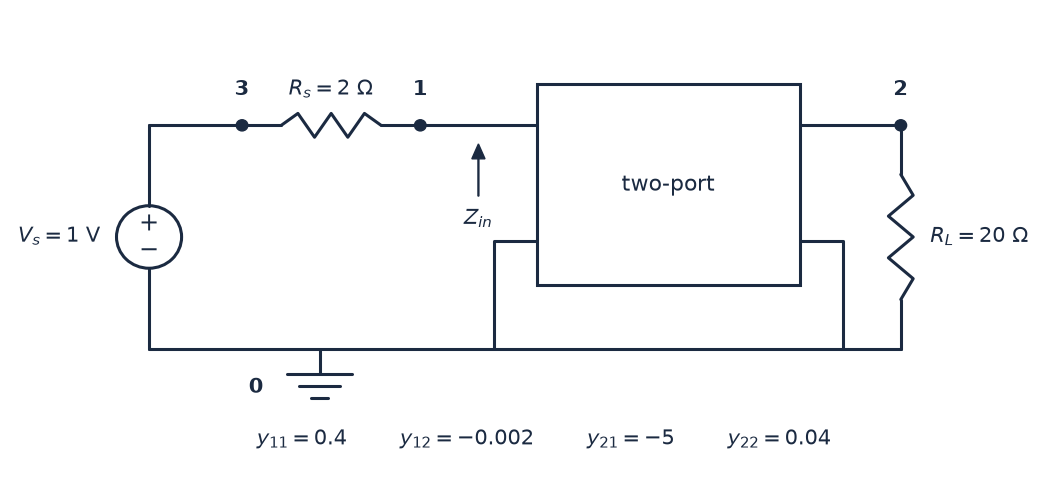
For the circuit, find Gv, Gi, Gp and Zin. The two-port has y parameters y11 = 0.4 S, y12 = −0.002 S, y21 = −5 S and y22 = 0.04 S.
Gain Example 1
Solution
The source is 1 V because its value does not matter to a gain — it cancels. A symbolic vs would do just as well.
"es,3,0,1:rs,3,1,2:rl,2,0,20:y,1,2"→cir:s\dc(cir)s\gain()Av 55.6, Ai -9.62, Ap 534, Zin 3.46 ΩThese are correct.
Gain Example 2
Find Gv, Gi, Gp and Zin for a two-port with z parameters z11 = 4 Ω, z12 = 1.5 Ω, z21 = 10 Ω and z22 = 3 Ω, driven by a source Vs with 5 Ω in series and loaded with 2 Ω.
There is no picture of this one — the description below is the whole circuit.
Solution
The same shape as before, with z parameters instead of y.
"es,3,0,1:rs,3,1,5:rl,2,0,2:z,1,2"→cir:s\dc(cir)When prompted, specify DC as the analysis and z as the parameter type. You can store the parameters in variables beforehand or type them when asked.
s\gain()It asks for the in voltage, in current, out voltage and out current. Type v1, izp1, v2 and izp2 respectively.
Gv 4, Gi -2, Gp 8, Zin 1 ΩThese are correct.